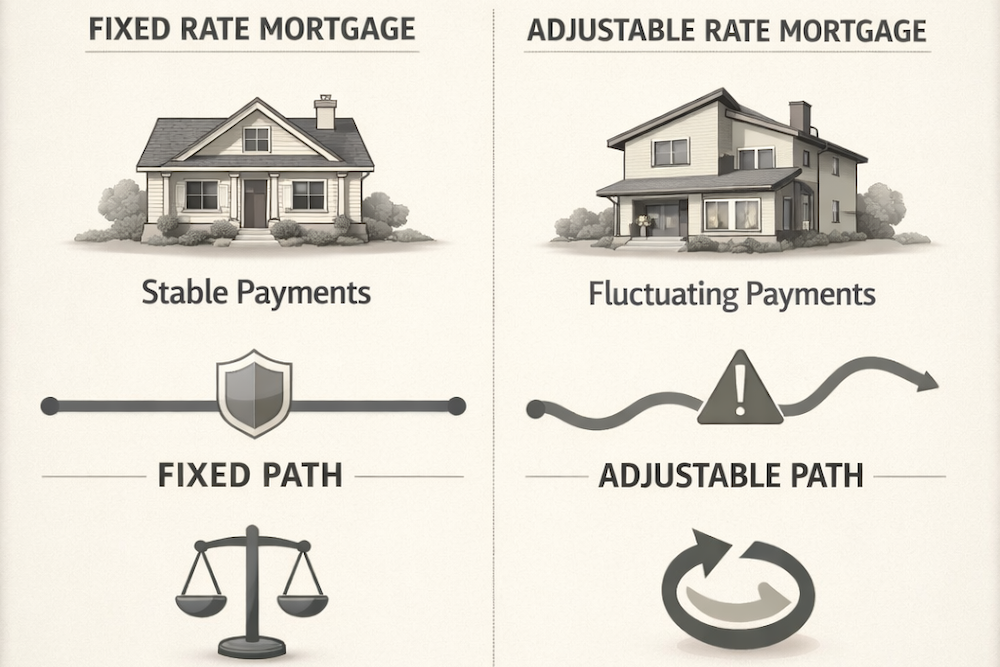
Choosing between a fixed-rate and adjustable-rate mortgage ranks among the most consequential financial decisions you’ll make as a homebuyer. The mortgage you select doesn’t just determine your monthly payment—it shapes your financial flexibility, risk exposure, and long-term wealth building strategy. With the Federal Reserve’s recent monetary policy shifts creating volatility in interest rates, understanding how each mortgage type performs in real-world scenarios has never been more critical. This article breaks down the practical implications of both options, helping you align your mortgage choice with your actual life circumstances and financial goals.
Fixed vs Adjustable: The Career Climber’s Dilemma
Meet Sarah, a 29-year-old marketing professional who just accepted a job in Austin. She expects significant salary increases over the next five years as she climbs the corporate ladder. Sarah’s situation perfectly illustrates when an adjustable-rate mortgage (ARM) makes sense. She chose a 5/1 ARM with a lower initial rate than fixed options, saving approximately $300 monthly during the first five years. This savings went directly into her investment portfolio and emergency fund.
Sarah’s gamble paid off because she understood her timeline. ARMs typically offer lower initial rates because lenders transfer some interest rate risk to borrowers. For someone planning to move, refinance, or substantially increase their income within the fixed-rate period, this trade-off works beautifully. The key lies in honest self-assessment about your career trajectory and housing plans.
However, Sarah’s colleague James made a different choice. He opted for a 30-year fixed mortgage at 6.5% because he values predictability above all else. James plans to start a family soon, and his spouse intends to shift to part-time work. The guaranteed payment gives them budgeting certainty during a major life transition. Neither choice was wrong—they simply matched different life scenarios.
The Refinancing Window Reality
The refinancing landscape has transformed dramatically with digital mortgage platforms. Fintech companies like Better.com and Rocket Mortgage have streamlined the process, reducing costs and timeline friction. This evolution makes ARMs more attractive than they were a decade ago. If rates drop during your ARM’s adjustable period, you can refinance more easily and affordably than ever before.
Consider Michael and Lisa, who purchased their home in 2021 with a 7/1 ARM at 2.75%. When rates spiked in 2022-2023, they felt relieved knowing they had five more years of rate stability. They’re now monitoring the market for refinancing opportunities, using automated tools that alert them when rates drop to beneficial levels. This strategic approach combines ARM benefits with modern refinancing accessibility.
The regulatory environment also protects consumers better than in the pre-2008 era. The Consumer Financial Protection Bureau (CFPB) enforces strict disclosure requirements, ensuring borrowers understand ARM adjustment caps, indexes, and worst-case scenarios. This transparency helps borrowers make informed decisions rather than gambling blindly on future rate movements.
Risk Tolerance and Sleep-at-Night Factor
Your psychological relationship with financial risk matters more than spreadsheets suggest. Fixed-rate mortgages appeal to people who view their home payment as a foundational expense that shouldn’t fluctuate. This mindset isn’t irrational—it reflects legitimate risk management preferences. When you lock in a fixed rate, you eliminate one major variable from your financial equation.
ARM borrowers must possess both financial cushion and emotional resilience. Even with rate caps limiting how much your payment can increase, you need reserves to handle potential adjustments. Industry experts recommend maintaining at least six months of the maximum possible payment in liquid savings. Without this buffer, an ARM can transform from a smart financial move into a source of chronic stress.
The current economic environment adds another layer of complexity. Inflation concerns and Federal Reserve policy uncertainty make rate predictions particularly challenging. Some economists forecast rate decreases as inflation moderates, which would benefit ARM holders. Others warn that persistent inflation could keep rates elevated longer than expected. Your mortgage choice essentially becomes a bet on macroeconomic trends.
How Rate Types Impact Your Monthly Budget
Monthly mortgage payments represent just one component of homeownership costs. Property taxes, insurance, maintenance, and HOA fees add substantial expenses. Fixed mortgages help you plan for these additional costs because your principal and interest remain constant. You can accurately project your total housing expense five or ten years forward.
ARM holders face more complex budgeting challenges. You must plan for payment increases while accounting for other rising costs. Smart ARM borrowers create tiered budgets with best-case, expected-case, and worst-case scenarios. They automate savings to build cushions before rate adjustments hit. This disciplined approach turns potential volatility into manageable risk.
The integration of personal finance apps with mortgage accounts has revolutionized budget management. Platforms like Mint and YNAB now incorporate mortgage data, helping users visualize how rate adjustments affect their overall financial picture. These tools make ARM management more practical than when borrowers tracked everything manually.
Building Equity and Wealth Accumulation
Your mortgage type influences equity building differently than many borrowers realize. ARM borrowers who save the initial rate differential and invest it wisely can potentially build more wealth than fixed-rate borrowers. If Sarah invests her $300 monthly ARM savings at a 7% average annual return, she accumulates approximately $21,500 over five years—a significant head start on wealth building.
Fixed-rate borrowers build wealth through certainty and forced savings. Every payment includes a predictable principal portion that increases your equity stake. This automatic wealth accumulation appeals to people who struggle with investment discipline. Your home becomes a savings vehicle that operates regardless of your other financial habits.
The tax implications also vary subtly between mortgage types. Mortgage interest deductibility benefits both options, but ARM borrowers initially deduct less interest due to lower rates. However, the Tax Cuts and Jobs Act of 2017 increased the standard deduction, making mortgage interest deductions less valuable for many households. This change diminishes one traditional advantage of higher-interest fixed mortgages.
Life Events and Flexibility Needs
Major life transitions often trigger mortgage reconsiderations. Marriage, divorce, career changes, and health issues can all affect your ideal mortgage structure. Fixed mortgages provide stability during turbulent times, while ARMs offer potential savings during prosperous periods. The question becomes: which uncertainty concerns you more—payment fluctuations or opportunity costs?
Digital mortgage platforms have introduced innovative hybrid products that blur traditional categories. Some lenders now offer mortgages with longer initial fixed periods—10/1 or even 15/1 ARMs—that combine extended stability with eventual rate adjustment potential. These products suit borrowers who want medium-term certainty without committing to 30-year rates.
Regulatory changes continue shaping mortgage accessibility and terms. The CFPB’s qualified mortgage rules ensure lenders verify your ability to repay under various scenarios. This protection helps prevent the predatory lending that contributed to the 2008 financial crisis. Modern mortgage shopping occurs in a more transparent, consumer-protective environment than previous generations experienced.
The fixed versus adjustable mortgage decision ultimately depends on your specific circumstances, risk tolerance, and financial goals rather than any universal “best” option. Fixed mortgages deliver peace of mind and budgeting simplicity, making them ideal for long-term homeowners who value stability above potential savings. ARMs offer lower initial costs and flexibility, rewarding borrowers with strong financial cushions and realistic timelines for moving or refinancing. As fintech innovations continue democratizing mortgage access and management, both options become increasingly viable for different life scenarios. The key lies in honest self-assessment: understand your career trajectory, evaluate your risk tolerance, and choose the mortgage that aligns with your actual life rather than theoretical ideal circumstances. With proper planning and realistic expectations, either choice can support your path to homeownership and long-term financial security.
References
- Consumer Financial Protection Bureau. “What is an adjustable rate mortgage (ARM)?” CFPB. https://www.consumerfinance.gov/ask-cfpb/what-is-an-adjustable-rate-mortgage-arm-en-103/
- Chen, James. “ARM vs. Fixed-Rate Mortgage: What’s the Difference?” Investopedia. https://www.investopedia.com/mortgage/mortgage-rates/fixed-vs-arm/
- Marquit, Miranda. “Fixed-Rate vs. Adjustable-Rate Mortgage: Which Should You Choose?” NerdWallet. https://www.nerdwallet.com/article/mortgages/fixed-rate-vs-adjustable-rate-mortgage
Choosing between a fixed-rate and adjustable-rate mortgage ranks among the most consequential financial decisions you’ll make as a homebuyer. The mortgage you select doesn’t just determine your monthly payment—it shapes your financial flexibility, risk exposure, and long-term wealth building strategy. With the Federal Reserve’s recent monetary policy shifts creating volatility in interest rates, understanding how each mortgage type performs in real-world scenarios has never been more critical. This article breaks down the practical implications of both options, helping you align your mortgage choice with your actual life circumstances and financial goals.
Fixed vs Adjustable: The Career Climber’s Dilemma
Meet Sarah, a 29-year-old marketing professional who just accepted a job in Austin. She expects significant salary increases over the next five years as she climbs the corporate ladder. Sarah’s situation perfectly illustrates when an adjustable-rate mortgage (ARM) makes sense. She chose a 5/1 ARM with a lower initial rate than fixed options, saving approximately $300 monthly during the first five years. This savings went directly into her investment portfolio and emergency fund.
Sarah’s gamble paid off because she understood her timeline. ARMs typically offer lower initial rates because lenders transfer some interest rate risk to borrowers. For someone planning to move, refinance, or substantially increase their income within the fixed-rate period, this trade-off works beautifully. The key lies in honest self-assessment about your career trajectory and housing plans.
However, Sarah’s colleague James made a different choice. He opted for a 30-year fixed mortgage at 6.5% because he values predictability above all else. James plans to start a family soon, and his spouse intends to shift to part-time work. The guaranteed payment gives them budgeting certainty during a major life transition. Neither choice was wrong—they simply matched different life scenarios.
The Refinancing Window Reality
The refinancing landscape has transformed dramatically with digital mortgage platforms. Fintech companies like Better.com and Rocket Mortgage have streamlined the process, reducing costs and timeline friction. This evolution makes ARMs more attractive than they were a decade ago. If rates drop during your ARM’s adjustable period, you can refinance more easily and affordably than ever before.
Consider Michael and Lisa, who purchased their home in 2021 with a 7/1 ARM at 2.75%. When rates spiked in 2022-2023, they felt relieved knowing they had five more years of rate stability. They’re now monitoring the market for refinancing opportunities, using automated tools that alert them when rates drop to beneficial levels. This strategic approach combines ARM benefits with modern refinancing accessibility.
The regulatory environment also protects consumers better than in the pre-2008 era. The Consumer Financial Protection Bureau (CFPB) enforces strict disclosure requirements, ensuring borrowers understand ARM adjustment caps, indexes, and worst-case scenarios. This transparency helps borrowers make informed decisions rather than gambling blindly on future rate movements.
Risk Tolerance and Sleep-at-Night Factor
Your psychological relationship with financial risk matters more than spreadsheets suggest. Fixed-rate mortgages appeal to people who view their home payment as a foundational expense that shouldn’t fluctuate. This mindset isn’t irrational—it reflects legitimate risk management preferences. When you lock in a fixed rate, you eliminate one major variable from your financial equation.
ARM borrowers must possess both financial cushion and emotional resilience. Even with rate caps limiting how much your payment can increase, you need reserves to handle potential adjustments. Industry experts recommend maintaining at least six months of the maximum possible payment in liquid savings. Without this buffer, an ARM can transform from a smart financial move into a source of chronic stress.
The current economic environment adds another layer of complexity. Inflation concerns and Federal Reserve policy uncertainty make rate predictions particularly challenging. Some economists forecast rate decreases as inflation moderates, which would benefit ARM holders. Others warn that persistent inflation could keep rates elevated longer than expected. Your mortgage choice essentially becomes a bet on macroeconomic trends.
How Rate Types Impact Your Monthly Budget
Monthly mortgage payments represent just one component of homeownership costs. Property taxes, insurance, maintenance, and HOA fees add substantial expenses. Fixed mortgages help you plan for these additional costs because your principal and interest remain constant. You can accurately project your total housing expense five or ten years forward.
ARM holders face more complex budgeting challenges. You must plan for payment increases while accounting for other rising costs. Smart ARM borrowers create tiered budgets with best-case, expected-case, and worst-case scenarios. They automate savings to build cushions before rate adjustments hit. This disciplined approach turns potential volatility into manageable risk.
The integration of personal finance apps with mortgage accounts has revolutionized budget management. Platforms like Mint and YNAB now incorporate mortgage data, helping users visualize how rate adjustments affect their overall financial picture. These tools make ARM management more practical than when borrowers tracked everything manually.
Building Equity and Wealth Accumulation
Your mortgage type influences equity building differently than many borrowers realize. ARM borrowers who save the initial rate differential and invest it wisely can potentially build more wealth than fixed-rate borrowers. If Sarah invests her $300 monthly ARM savings at a 7% average annual return, she accumulates approximately $21,500 over five years—a significant head start on wealth building.
Fixed-rate borrowers build wealth through certainty and forced savings. Every payment includes a predictable principal portion that increases your equity stake. This automatic wealth accumulation appeals to people who struggle with investment discipline. Your home becomes a savings vehicle that operates regardless of your other financial habits.
The tax implications also vary subtly between mortgage types. Mortgage interest deductibility benefits both options, but ARM borrowers initially deduct less interest due to lower rates. However, the Tax Cuts and Jobs Act of 2017 increased the standard deduction, making mortgage interest deductions less valuable for many households. This change diminishes one traditional advantage of higher-interest fixed mortgages.
Life Events and Flexibility Needs
Major life transitions often trigger mortgage reconsiderations. Marriage, divorce, career changes, and health issues can all affect your ideal mortgage structure. Fixed mortgages provide stability during turbulent times, while ARMs offer potential savings during prosperous periods. The question becomes: which uncertainty concerns you more—payment fluctuations or opportunity costs?
Digital mortgage platforms have introduced innovative hybrid products that blur traditional categories. Some lenders now offer mortgages with longer initial fixed periods—10/1 or even 15/1 ARMs—that combine extended stability with eventual rate adjustment potential. These products suit borrowers who want medium-term certainty without committing to 30-year rates.
Regulatory changes continue shaping mortgage accessibility and terms. The CFPB’s qualified mortgage rules ensure lenders verify your ability to repay under various scenarios. This protection helps prevent the predatory lending that contributed to the 2008 financial crisis. Modern mortgage shopping occurs in a more transparent, consumer-protective environment than previous generations experienced.
The fixed versus adjustable mortgage decision ultimately depends on your specific circumstances, risk tolerance, and financial goals rather than any universal “best” option. Fixed mortgages deliver peace of mind and budgeting simplicity, making them ideal for long-term homeowners who value stability above potential savings. ARMs offer lower initial costs and flexibility, rewarding borrowers with strong financial cushions and realistic timelines for moving or refinancing. As fintech innovations continue democratizing mortgage access and management, both options become increasingly viable for different life scenarios. The key lies in honest self-assessment: understand your career trajectory, evaluate your risk tolerance, and choose the mortgage that aligns with your actual life rather than theoretical ideal circumstances. With proper planning and realistic expectations, either choice can support your path to homeownership and long-term financial security.
References
- Consumer Financial Protection Bureau. “What is an adjustable rate mortgage (ARM)?” CFPB. https://www.consumerfinance.gov/ask-cfpb/what-is-an-adjustable-rate-mortgage-arm-en-103/
- Chen, James. “ARM vs. Fixed-Rate Mortgage: What’s the Difference?” Investopedia. https://www.investopedia.com/mortgage/mortgage-rates/fixed-vs-arm/
- Marquit, Miranda. “Fixed-Rate vs. Adjustable-Rate Mortgage: Which Should You Choose?” NerdWallet. https://www.nerdwallet.com/article/mortgages/fixed-rate-vs-adjustable-rate-mortgage




)