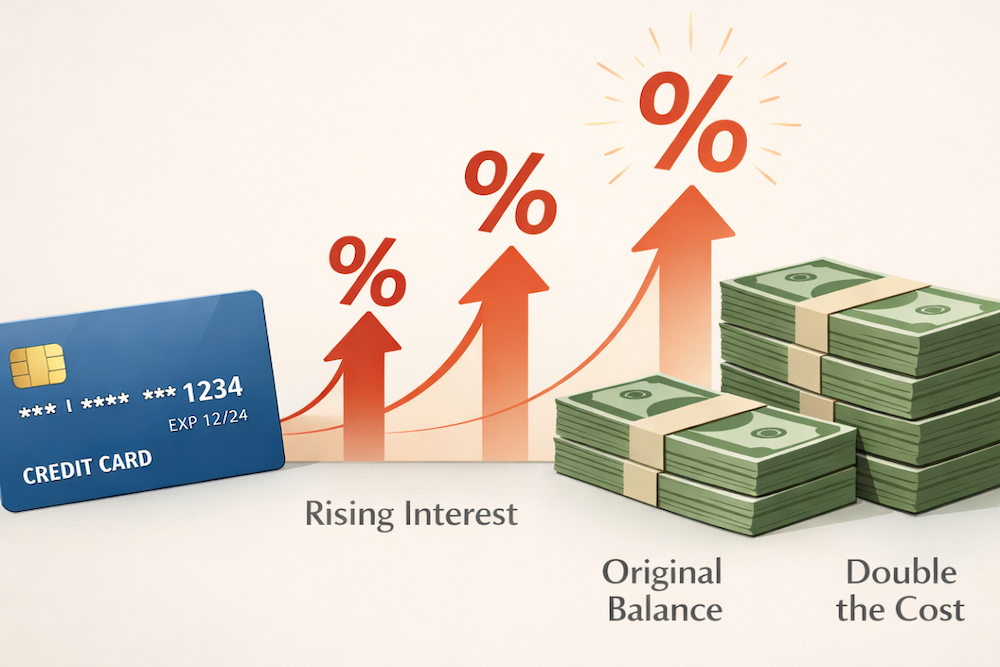
You swipe your credit card for a $2,000 laptop, planning to pay it off over the next year. Fast forward twelve months, and you’ve somehow paid $2,800. Where did that extra $800 come from? Credit card interest works in ways that most people don’t fully understand, and this lack of knowledge costs Americans billions of dollars annually. The mechanics behind credit card interest calculations aren’t exactly advertised in bold letters by card issuers. Understanding how interest compounds daily and how minimum payments barely scratch the surface of your actual debt can save you thousands of dollars over your lifetime.
The Minimum Payment Trap That Doubles Your Debt
Credit card statements make minimum payments look deceptively manageable. You see a $3,000 balance with a $75 minimum payment and think you’re making progress. The math tells a different story. Card issuers typically calculate minimum payments as 1-3% of your total balance, which barely covers the interest charges accumulating each month.
Let’s break down a real scenario. You carry a $5,000 balance on a card with an 18% APR. Your minimum payment starts around $150. You pay that amount faithfully each month. It will take you approximately 17 years to pay off that debt. The total amount you’ll pay? Over $9,000. You’ve literally paid almost double the original amount you borrowed, and that’s assuming you never add another purchase to the card.
The psychological trap works perfectly. You feel responsible because you’re making payments on time. Your credit score might even improve. Meanwhile, the principal balance decreases at a snail’s pace. Card issuers designed this system intentionally. They profit most when cardholders pay the minimum for extended periods.
Why Minimum Payments Barely Touch Principal
The structure of minimum payments prioritizes interest over principal reduction. During the first several months of minimum payments, you’re essentially paying the interest that accumulated that month plus a tiny fraction toward your actual debt. This creates a hamster wheel effect where you’re running but barely moving forward.
Consider the monthly breakdown. On that $5,000 balance at 18% APR, roughly $75 of your $150 minimum payment goes straight to interest charges. Only $75 chips away at your actual debt. Next month, you’ve reduced your balance by just $75, but interest continues calculating on the remaining $4,925. The cycle repeats with diminishing effectiveness.
Financial advisors consistently recommend paying significantly more than the minimum. Even an extra $50 per month can cut years off your repayment timeline. According to NerdWallet’s credit card calculator, increasing your payment from $150 to $200 monthly on that $5,000 balance reduces your payoff time from 17 years to just 3 years. You’d save over $4,000 in interest charges.
How Card Issuers Calculate Interest Daily
Most people think credit card interest calculates monthly. Card issuers actually calculate interest daily, which significantly increases what you ultimately pay. They take your annual percentage rate (APR), divide it by 365, and apply that daily rate to your balance every single day. This daily compounding accelerates your debt growth faster than simple monthly calculations would.
Here’s the actual math. An 18% APR becomes approximately 0.0493% daily. That seems tiny until you realize it applies to your balance every day. If you carry a $3,000 balance, you’re adding about $1.48 in interest charges daily. Over a 30-day month, that’s $44.40 in interest before you’ve paid anything. The interest itself starts accruing interest the next day.
This daily compounding explains why your balance seems to barely move despite making payments. The Consumer Financial Protection Bureau has noted that this calculation method, while standard across the industry, often surprises cardholders who expect simpler interest calculations. Understanding this mechanism helps you strategize payment timing and amounts more effectively.
The Grace Period Loophole
Credit cards offer one powerful tool to avoid interest entirely: the grace period. Most cards provide 21-25 days between your statement closing date and payment due date. Pay your entire statement balance during this window, and you won’t pay any interest charges. This loophole lets you essentially borrow money free for up to two months.
The grace period disappears the moment you carry a balance. Once you fail to pay in full, card issuers start calculating interest from the purchase date, not from when your payment was due. New purchases also lose their grace period immediately. You’ve entered what financial experts call “revolving credit mode,” where interest compounds daily on everything.
Getting back into grace period territory requires paying your entire balance in full. Some people don’t realize that paying just $10 less than the full statement balance triggers interest on the entire amount. Card issuers restored grace periods only after receiving zero balance for at least one billing cycle. This policy varies by issuer, making it crucial to read your specific card agreement carefully.
How Payment Timing Affects Interest
When you submit your payment during the month matters more than most people realize. Card issuers calculate your average daily balance throughout the billing cycle. Paying early reduces this average, which directly reduces your interest charges. A payment made on the 5th of the month saves you more money than the same payment made on the 25th.
Strategic payment timing can save significant money for those carrying balances. Split your monthly payment into two smaller payments made two weeks apart. This approach reduces your average daily balance more effectively than one lump sum payment. Some cardholders schedule weekly payments to continuously chip away at the balance on which interest calculates.
The fintech industry has recognized this opportunity. Apps like Tally and Qoins now help users optimize payment timing and amounts automatically. These digital solutions connect to your bank account and credit cards, analyzing the best moments to make payments based on your cash flow and interest calculation patterns. Such technological integration represents how digital transformation is reshaping consumer relationships with credit products.
Credit card interest operates as a sophisticated system designed to maximize issuer profits while maintaining an illusion of affordability through low minimum payments. The daily compounding of interest combined with minimum payment structures creates a perfect storm where cardholders can easily pay double their original purchase price without realizing it.
However, armed with knowledge about how interest calculates and how minimum payments work, you can make strategic decisions that save thousands of dollars. Pay more than the minimum whenever possible, time your payments strategically throughout the month, and treat the grace period as your most valuable credit card feature.
The regulatory landscape continues evolving as the Consumer Financial Protection Bureau pushes for greater transparency in credit card terms, but ultimately, your financial outcome depends on understanding these mechanics and acting accordingly. The difference between financial stress and financial freedom often comes down to these seemingly small decisions about how you manage credit card debt.
References
- Consumer Financial Protection Bureau. “What is a grace period for a credit card?” https://www.consumerfinance.gov/ask-cfpb/what-is-a-grace-period-for-a-credit-card-en-47/
- NerdWallet. “Credit Card Interest Calculator: See How Much Interest You’ll Pay.” https://www.nerdwallet.com/article/credit-cards/credit-card-interest-calculator
- Federal Reserve. “Consumer Credit – G.19.” https://www.federalreserve.gov/releases/g19/current/
You swipe your credit card for a $2,000 laptop, planning to pay it off over the next year. Fast forward twelve months, and you’ve somehow paid $2,800. Where did that extra $800 come from? Credit card interest works in ways that most people don’t fully understand, and this lack of knowledge costs Americans billions of dollars annually. The mechanics behind credit card interest calculations aren’t exactly advertised in bold letters by card issuers. Understanding how interest compounds daily and how minimum payments barely scratch the surface of your actual debt can save you thousands of dollars over your lifetime.
The Minimum Payment Trap That Doubles Your Debt
Credit card statements make minimum payments look deceptively manageable. You see a $3,000 balance with a $75 minimum payment and think you’re making progress. The math tells a different story. Card issuers typically calculate minimum payments as 1-3% of your total balance, which barely covers the interest charges accumulating each month.
Let’s break down a real scenario. You carry a $5,000 balance on a card with an 18% APR. Your minimum payment starts around $150. You pay that amount faithfully each month. It will take you approximately 17 years to pay off that debt. The total amount you’ll pay? Over $9,000. You’ve literally paid almost double the original amount you borrowed, and that’s assuming you never add another purchase to the card.
The psychological trap works perfectly. You feel responsible because you’re making payments on time. Your credit score might even improve. Meanwhile, the principal balance decreases at a snail’s pace. Card issuers designed this system intentionally. They profit most when cardholders pay the minimum for extended periods.
Why Minimum Payments Barely Touch Principal
The structure of minimum payments prioritizes interest over principal reduction. During the first several months of minimum payments, you’re essentially paying the interest that accumulated that month plus a tiny fraction toward your actual debt. This creates a hamster wheel effect where you’re running but barely moving forward.
Consider the monthly breakdown. On that $5,000 balance at 18% APR, roughly $75 of your $150 minimum payment goes straight to interest charges. Only $75 chips away at your actual debt. Next month, you’ve reduced your balance by just $75, but interest continues calculating on the remaining $4,925. The cycle repeats with diminishing effectiveness.
Financial advisors consistently recommend paying significantly more than the minimum. Even an extra $50 per month can cut years off your repayment timeline. According to NerdWallet’s credit card calculator, increasing your payment from $150 to $200 monthly on that $5,000 balance reduces your payoff time from 17 years to just 3 years. You’d save over $4,000 in interest charges.
How Card Issuers Calculate Interest Daily
Most people think credit card interest calculates monthly. Card issuers actually calculate interest daily, which significantly increases what you ultimately pay. They take your annual percentage rate (APR), divide it by 365, and apply that daily rate to your balance every single day. This daily compounding accelerates your debt growth faster than simple monthly calculations would.
Here’s the actual math. An 18% APR becomes approximately 0.0493% daily. That seems tiny until you realize it applies to your balance every day. If you carry a $3,000 balance, you’re adding about $1.48 in interest charges daily. Over a 30-day month, that’s $44.40 in interest before you’ve paid anything. The interest itself starts accruing interest the next day.
This daily compounding explains why your balance seems to barely move despite making payments. The Consumer Financial Protection Bureau has noted that this calculation method, while standard across the industry, often surprises cardholders who expect simpler interest calculations. Understanding this mechanism helps you strategize payment timing and amounts more effectively.
The Grace Period Loophole
Credit cards offer one powerful tool to avoid interest entirely: the grace period. Most cards provide 21-25 days between your statement closing date and payment due date. Pay your entire statement balance during this window, and you won’t pay any interest charges. This loophole lets you essentially borrow money free for up to two months.
The grace period disappears the moment you carry a balance. Once you fail to pay in full, card issuers start calculating interest from the purchase date, not from when your payment was due. New purchases also lose their grace period immediately. You’ve entered what financial experts call “revolving credit mode,” where interest compounds daily on everything.
Getting back into grace period territory requires paying your entire balance in full. Some people don’t realize that paying just $10 less than the full statement balance triggers interest on the entire amount. Card issuers restored grace periods only after receiving zero balance for at least one billing cycle. This policy varies by issuer, making it crucial to read your specific card agreement carefully.
How Payment Timing Affects Interest
When you submit your payment during the month matters more than most people realize. Card issuers calculate your average daily balance throughout the billing cycle. Paying early reduces this average, which directly reduces your interest charges. A payment made on the 5th of the month saves you more money than the same payment made on the 25th.
Strategic payment timing can save significant money for those carrying balances. Split your monthly payment into two smaller payments made two weeks apart. This approach reduces your average daily balance more effectively than one lump sum payment. Some cardholders schedule weekly payments to continuously chip away at the balance on which interest calculates.
The fintech industry has recognized this opportunity. Apps like Tally and Qoins now help users optimize payment timing and amounts automatically. These digital solutions connect to your bank account and credit cards, analyzing the best moments to make payments based on your cash flow and interest calculation patterns. Such technological integration represents how digital transformation is reshaping consumer relationships with credit products.
Credit card interest operates as a sophisticated system designed to maximize issuer profits while maintaining an illusion of affordability through low minimum payments. The daily compounding of interest combined with minimum payment structures creates a perfect storm where cardholders can easily pay double their original purchase price without realizing it.
However, armed with knowledge about how interest calculates and how minimum payments work, you can make strategic decisions that save thousands of dollars. Pay more than the minimum whenever possible, time your payments strategically throughout the month, and treat the grace period as your most valuable credit card feature.
The regulatory landscape continues evolving as the Consumer Financial Protection Bureau pushes for greater transparency in credit card terms, but ultimately, your financial outcome depends on understanding these mechanics and acting accordingly. The difference between financial stress and financial freedom often comes down to these seemingly small decisions about how you manage credit card debt.
References
- Consumer Financial Protection Bureau. “What is a grace period for a credit card?” https://www.consumerfinance.gov/ask-cfpb/what-is-a-grace-period-for-a-credit-card-en-47/
- NerdWallet. “Credit Card Interest Calculator: See How Much Interest You’ll Pay.” https://www.nerdwallet.com/article/credit-cards/credit-card-interest-calculator
- Federal Reserve. “Consumer Credit – G.19.” https://www.federalreserve.gov/releases/g19/current/

', 'Most cardholders don’t realize they’re paying interest on interest itself.
' ,'https://personalloanservice.net/wp-content/uploads/2025/12/Credit-Card-Interest.png'))